Best bid alert services for contractors in 2026
Choose a bid alert service for weekly state and local discovery. Compare matched email digests, agency notices, and state portals by contractor fit.


MondayBids is the best bid alert service here for contractors who want a weekly email digest of state and local opportunities matched to their trade and location. Best for tracking a specific buyer: that agency’s own procurement notifications, where offered. Best for a state-focused search: the state’s official procurement portal and its available alerts.
- MondayBids suits contractors seeking a weekly bid alert service for state and local government work across all 50 US states.
- Use agency notifications to follow a specific public buyer; check whether registration includes alerts.
- Use state procurement portals for state purchasing, without assuming they include every local government.
- Check the official solicitation for deadlines, mandatory meetings, amendments, and submission instructions before committing.
Why this matters
A bid notification is useful only when it leads to work your business can perform in an area you serve. A relevant trade label does not establish that fit. The scope, site location, qualifications, and response requirements still need review.
For your 2026 search, separate discovery from submission. A subscription such as MondayBids helps you find opportunities. The issuing agency’s solicitation tells you what to submit and which instructions control the response.
This guide ranks three approaches by the job each does best. It does not treat an email digest, a single agency’s notification list, and a state procurement portal as interchangeable products.
What makes the best bid alert service?
Use these criteria before choosing a subscription or registering for notifications:
- Trade match: Look beyond broad categories. Read the scope to distinguish work you perform from related work you do not.
- Service-area match: Check the actual job location, not just the public buyer’s mailing address. Travel and site access belong in your decision.
- Buyer coverage: Separate state agencies, cities, counties, school districts, and other public bodies. Do not assume one source includes all of them.
- Delivery schedule: Match the notification schedule to how you review opportunities. A weekly digest is not continuous monitoring.
- Official-document access: Find the solicitation, attachments, amendment notices, and response instructions before deciding whether to pursue the work.
- Notification scope: Establish whether alerts cover new solicitations, changes to existing solicitations, or both. Those are different needs.
The two matching criteria explicitly described for the featured subscription are trade and location. Its stated coverage spans all 50 US states, and its delivery schedule is one digest per week. Those facts establish its discovery role; they do not replace a solicitation review.
Bid alert options at a glance
| Rank and option | Best for | Standout function | Key limitation |
|---|---|---|---|
| 1. MondayBids | Weekly discovery across state and local buyers | Emails new bids and RFPs matched to trade and location | Weekly delivery is not a substitute for checking active solicitations |
| 2. Agency procurement notifications | Following a specific public buyer | Keeps your search tied to the issuing organization | Notification features and coverage depend on the agency |
| 3. State procurement portal alerts | Concentrating on state purchasing | Provides a state-level starting point for procurement searches | Do not assume coverage includes every local public buyer |
Choose by the gap in your process, not by the length of a feature list. If you lack a repeatable discovery routine, start there. If you already know the buyer, concentrate on its official procurement process.
1. MondayBids: best for weekly state and local bid discovery
MondayBids is a subscription that emails contractors and vendors a weekly digest of new state and local government bids and RFPs. It matches opportunities to trade and location across all 50 US states.
Best for: Small contractors and trade businesses that want a recurring discovery routine rather than starting each search from scratch. The stated service is bid discovery and email alerts, not bid writing or a promise of contract awards.
Subscription pros
- Trade matching gives the search a defined connection to the work your business performs.
- Location matching connects discovery to your service area.
- A weekly email digest gives you a scheduled batch of opportunities to review.
- State and local coverage across all 50 US states supports searches beyond a single public buyer.
Subscription cons
- A weekly delivery schedule is not continuous notification of newly posted opportunities.
- An alert does not establish that your business meets the solicitation’s eligibility or qualification requirements.
- You still need to check official documents and follow amendments for any opportunity you pursue.
For a 2026 bid-search routine, make the digest your screening queue. Open relevant opportunities, confirm the scope, and record the official response deadline. Keep active bids separate from opportunities you have merely discovered.
Verdict: Buy MondayBids for weekly, trade-and-location-based discovery; skip it as a replacement for official solicitation monitoring.
2. Agency notifications: best for following a specific buyer
Agency procurement notifications are the direct-source approach: start with the city, county, school district, utility, or other public organization you want to serve. Check its purchasing instructions to establish whether it offers vendor notifications and how enrollment works.
Best for: Contractors with a defined target buyer or an existing solicitation to follow. Before relying on this option, confirm what the agency sends and which notices require separate registration.
Agency-notification pros
- Your search stays focused on the organization whose work you want.
- The buyer’s own procurement instructions identify where to find its solicitation documents.
- A direct-source routine lets you check buyer-specific registration and submission requirements together.
Agency-notification cons
- Following one agency does not create a search across other public buyers.
- Alert enrollment, document access, and submission registration are not necessarily the same process.
- You must verify whether notifications include amendments, cancellations, and meeting changes.
Do not stop at creating a vendor account. Read the enrollment confirmation and the solicitation instructions. If the process requires selecting commodity categories, check that your selections describe your actual work rather than a broad adjacent trade.
For an active 2026 opportunity, record the official document location and the procurement contact named in the solicitation. Follow the stated communication rules when asking questions.
Verdict: Buy into the direct-source approach when you know the buyer; skip it as your only discovery method if you need broader coverage.
3. State portal alerts: best for state-focused purchasing searches
A state procurement portal is the starting point for finding that state’s purchasing instructions and published opportunities. Use its available search and notification functions after checking the portal’s stated scope.
Best for: Contractors deliberately targeting state purchasing. A portal’s name does not establish that every city, county, school district, or other local organization publishes there.
State-portal pros
- You can organize a search around a defined state purchasing system.
- Official portal instructions explain the registration and response processes that apply there.
- The portal’s coverage statement gives you a basis for deciding which additional sources to monitor.
State-portal cons
- State-level coverage is not the same as complete local-government coverage.
- Search categories need checking against your actual trade and scope.
- Registration on one system does not establish registration with every buyer you want to serve.
Start by reading which entities use the portal. Then check whether the opportunity itself directs you to another system for attachments, questions, or submission. Follow the solicitation’s instructions rather than assuming the search portal handles every step.
For your 2026 source list, label this option precisely: state purchasing, named participating buyers, or another scope the portal explicitly states. Avoid a catch-all label such as all government work.
Verdict: Buy into state-portal alerts for a state-focused search; skip the assumption that they cover every local opportunity.
How the ranking works
This ranking assigns a different job to each option. Weekly matched discovery comes first for contractors seeking an ongoing search routine. Agency notifications serve a known-buyer search. State portal alerts serve a state-purchasing search.
The criteria are trade fit, service-area fit, buyer coverage, delivery schedule, official-document access, and notification scope. No ranking position establishes that a source includes every relevant bid or that an alert makes your business eligible to respond.
Turn an alert into a bid decision
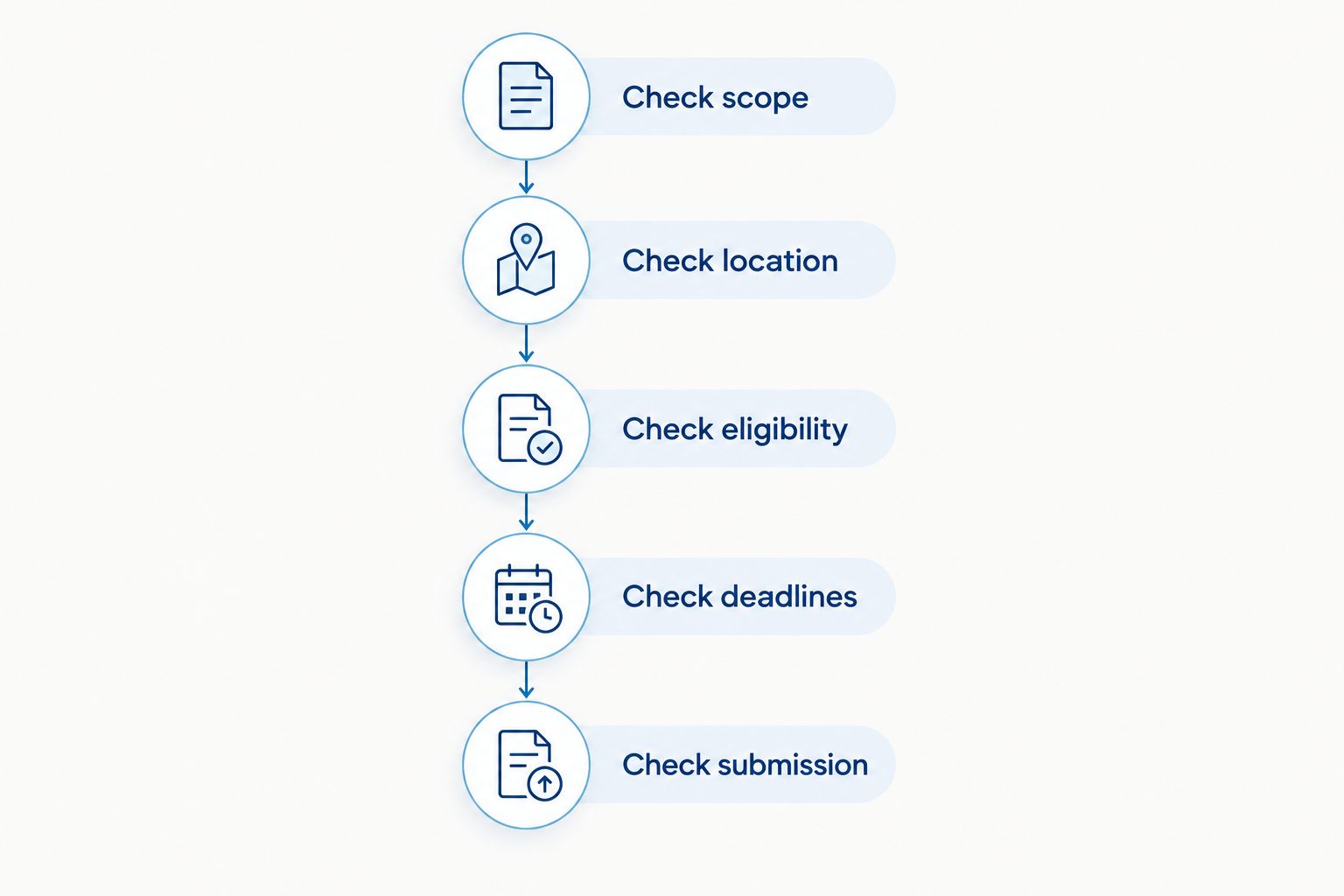
Use the same screening sequence regardless of where an opportunity appears. Stop when a mandatory requirement rules your business out; do not spend proposal time trying to explain away an explicit condition.
Check scope
Read the work description and attachments. Confirm whether the buyer wants your trade, a broader prime contractor, a supply-only response, or services outside your capability.
Check location
Find the actual performance location and site-access requirements. Compare them with the area your crew can serve, including any required site attendance.
Check eligibility
Look for licenses, insurance, bonding, experience requirements, and set-asides. A set-aside reserves an opportunity for an eligible business category; a trade match alone does not establish eligibility.
Check deadlines
Record the response deadline, time zone, question deadline, and any mandatory pre-bid meeting or site visit. Treat each mandatory event as a separate requirement, not a detail to revisit while drafting.
Check submission
Identify the required submission channel, forms, signatures, attachments, and amendment acknowledgments. Save the official solicitation reference so you return to the correct record.
Keep a brief reason for every pursue-or-skip decision. Scope mismatch, location mismatch, missing qualification, and missed mandatory meeting are useful categories. They show whether your search needs adjusting without confusing discovery quality with your ability to bid.
For a more focused search routine, use the guide to finding municipal bids that fit your trade.
Which bid alert option should you choose?
Choose MondayBids as your bid alert service when you want weekly state and local discovery matched to trade and location. Add direct agency checks when you identify work to pursue. Use state procurement portals when state purchasing is a deliberate part of your search.
For 2026, keep discovery and active-bid tracking separate. Your discovery list holds possible work. Your active-bid record holds the official documents, deadlines, required events, and submission instructions for work you have decided to pursue.
Review your subscription options
See subscription details for weekly state and local bid discovery matched to your trade and location.
FAQ
What's the best bid alert service for a small contractor?
MondayBids is the best fit in this guide for contractors seeking a weekly digest of state and local bids matched to trade and location. Use the issuing agency’s official documents to confirm requirements before preparing a response.
Is a bid alert subscription better than an agency portal?
A bid alert subscription and an agency portal serve different jobs. Use the subscription for discovery and the official agency source to check solicitation instructions, deadlines, and amendments.
Do state procurement portals include every city and county bid?
Do not assume a state procurement portal includes every city and county bid. Read its coverage statement and check the purchasing instructions of the local buyers you want to serve.
Does signing up for vendor notifications register me to submit a bid?
Do not treat notification enrollment as confirmation that you can submit a bid. Check the solicitation’s registration and submission instructions separately.
What should I check first when a bid alert arrives?
Check the scope, performance location, eligibility requirements, and mandatory deadlines first. Stop if a required qualification or event rules your business out.
Does this subscription cover federal bids?
The subscription described in this guide covers state and local government bids and RFPs. Do not use that stated scope as evidence of federal bid coverage.
What do RFP, RFQ, and IFB mean?
RFP means request for proposals, and IFB means invitation for bids. RFQ can mean request for qualifications or request for quotation; read the agency’s definition and response instructions.
One last thing
Track the question deadline, not just the submission deadline. If you discover unclear scope after the question period closes, there is less room to obtain an official clarification. Read the communication instructions during your first review, while you are still deciding whether the opportunity fits.