
Government contracts for small businesses: where to start
Find government contracts for small businesses by starting locally. Check trade fit, deadlines, registration, and bid requirements before you estimate.


Small-business government contracting is selling goods or services to public agencies with the aim of earning work that fits your capacity and service area. This guide to government contracts for small businesses focuses on state and local opportunities in 2026, where you must check each buyer’s registration rules, bid documents, deadlines, and submission instructions.
- Government contracts for small businesses start with matching your trade, service area, and qualifications to an agency’s requirements.
- MondayBids suits contractors seeking weekly state and local bid alerts, not federal opportunities or bid-writing services.
- Use official procurement documents to verify deadlines, mandatory site visits, insurance, and submission instructions.
- Start with a manageable scope; skip opportunities with requirements your business cannot meet.
Why government contracting matters for small businesses
Public agencies buy work and supplies that small businesses already provide: maintenance, repairs, construction, equipment, and professional services. The challenge is not simply finding a notice. You need to establish whether you can perform the work and submit a compliant response.
A small contractor has limited estimating time. A distant job, a missed mandatory walkthrough, or an insurance requirement you cannot satisfy makes a notice unsuitable even when its title matches your trade.
MondayBids is best for contractors seeking weekly state and local bid alerts matched to their trade and location. MondayBids emails a weekly digest across all 50 US states. Its role is discovery; you still need to read the agency’s documents and prepare your response.
For your 2026 search, keep federal procurement separate. This guide covers state and local buyers, and MondayBids does not cover federal bids. A registration or certification used in one procurement system does not automatically satisfy another agency’s requirements.
How to start finding suitable government contracts
Define your trade and service area
Start with the work you can deliver now, not every service you hope to offer. A useful search description names the task, the type of property or equipment involved, and your geographic limits. That gives you a way to reject irrelevant notices before opening every attachment.
Write a short capability sheet using a document or spreadsheet. Include your licenses, equipment, relevant completed work, and staffing constraints. This becomes your reference when an attractive notice stretches beyond your normal scope.
Set aside 30 minutes for this first exercise. The goal is a clear search boundary, not a polished sales brochure.
- List your core services using the terms buyers use in specifications.
- Separate work you perform directly from work requiring subcontractors.
- Define your service area by ZIP code, county, or travel distance.
- Record your current licenses and their expiration dates.
- Note scheduling limits, including emergency and after-hours work.
Find the agencies that buy your work
Use free searches first. Look for procurement or purchasing information from cities, counties, school districts, utilities, and state agencies within your service area. Some publish notices directly; others direct vendors to a shared bidding portal.
Open the agency’s official procurement page rather than relying only on a search-result summary. Check where it publishes opportunities, whether documents require an account, and how vendors receive amendments. A bookmark helps you return, but it does not replace registration when the solicitation requires it.
Start your 2026 watchlist with 3 agencies whose needs match your trade. Expand after you have a repeatable review process.
- Search the agency name with procurement, purchasing, bids, or vendor registration.
- Confirm that the notice identifies the actual issuing agency.
- Bookmark the official source and record any required portal account.
- Check whether vendor registration and bid submission use separate systems.
- Record the purchasing contact and the permitted question process.
Add alerts without replacing source checks
Manual searching gives you control, but checking multiple agencies takes repeated effort. Use a spreadsheet to track which sources you checked and when. If a portal offers notifications, configure them for the categories and locations relevant to your business.
MondayBids provides another discovery route: a weekly email digest of new state and local bids and RFPs matched to trade and location. It suits contractors who want opportunities delivered by email rather than making every search from scratch.
A weekly digest is not a deadline-monitoring system. Check the official source for each opportunity you pursue, including amendments issued after the original notice. Do not treat an email summary as the complete solicitation.
- Use specific trade terms and common descriptions of the same work.
- Match location settings to the area you can actually serve.
- Record the official document source for every shortlisted opportunity.
- Review incoming alerts against your capability sheet.
- Check amendments separately for any bid you are preparing.
Screen each notice before estimating
Read for disqualifiers before measuring quantities or requesting supplier quotes. A matching title does not establish a fit. A maintenance contract, for example, can include equipment, staffing, reporting, and response obligations beyond the headline service.
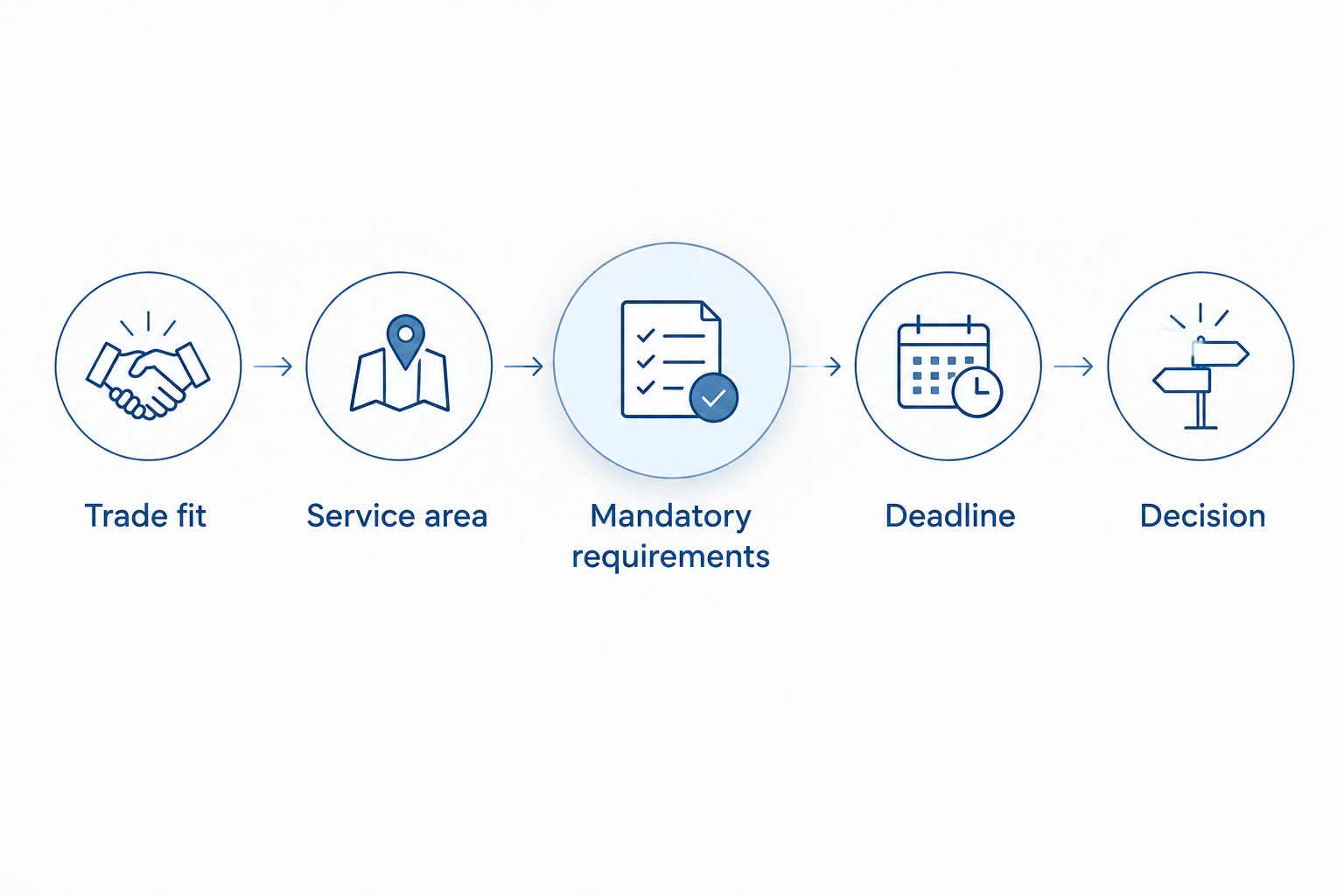
Use the same screening order each time: trade fit, service area, mandatory requirements, then deadline. Stop when a nonnegotiable requirement rules your business out. This protects estimating time without making assumptions about whether the agency will waive a condition.
Keep a brief reason for each decision. A record such as outside service area or mandatory meeting missed is more useful than an unexplained rejection.
- Trade fit: Confirm the actual tasks, quantities, and required deliverables.
- Service area: Check every work location and travel obligation.
- Mandatory requirements: Identify licenses, insurance, bonding, and required meetings.
- Deadline: Verify the due date, exact time, time zone, and submission method.
- Decision: Record pursue, clarify, or skip with a specific reason.
Read the solicitation and resolve questions
Download the complete solicitation, attachments, pricing forms, and posted amendments. Keep them together under the agency name and solicitation identifier. Check document dates so you do not prepare a response using a superseded form.
An IFB is an invitation for bids; an RFP is a request for proposals; an RFQ can mean a request for quotations or qualifications. Read the document’s own definition and evaluation criteria. The acronym alone does not tell you what to submit or how the agency will evaluate it.
For each 2026 opportunity, create a requirements checklist from the actual documents. If instructions conflict or scope is unclear, use the authorized question process before its deadline rather than guessing.
- List every required form, signature, attachment, and acknowledgment.
- Check whether a pre-bid meeting or site visit is mandatory.
- Read insurance, bonding, licensing, and subcontracting requirements.
- Verify eligibility for any stated small-business or other set-aside.
- Submit questions through the named channel before the question cutoff.
- Save written answers and amendments with the solicitation.
Build a bid-or-skip decision
Separate eligibility from commercial fit. You can satisfy every submission rule and still face a contract that does not suit your crew, equipment, schedule, or cash flow. Read performance obligations alongside the technical scope.
Review payment terms, invoicing requirements, mobilization needs, and the materials or labor you must fund before payment. Check whether the solicitation commits you to particular response times or service coverage. Do not assume those terms match your private-sector jobs.
Set a 20-minute review with the person responsible for delivery before authorizing a detailed estimate. This is a suggested working limit, not a procurement requirement. Escalate unresolved contract terms to an appropriate adviser.
- Confirm that your team can deliver the entire required scope.
- Check equipment access and any subcontractor dependencies.
- Review the schedule against existing commitments.
- Identify upfront spending and the stated payment process.
- Read change, cancellation, renewal, and performance provisions.
- Record the decision and assign responsibility for the response.
Submit correctly and track the result
Prepare your submission around the agency’s checklist, not your usual sales proposal. A persuasive description does not replace a required form, signature, acknowledgment, or attachment. Follow the prescribed file format and delivery method.
Leave time to resolve account access, upload, or document problems before the deadline. Confirm what counts as receipt: saving a draft in a portal is not the same as submitting it. Keep the confirmation or other evidence of delivery specified by the system.
Maintain a 2026 bid log after submission. Record the result and use any published award information or permitted feedback to improve your next decision.
- Check that every required field and attachment is complete.
- Acknowledge amendments exactly as instructed.
- Verify the submission deadline and time zone again.
- Confirm successful submission and save the receipt.
- Track the award notice or the agency’s stated next step.
- Record lessons about fit, estimating effort, and missing information.
Compare ways to find state and local bids
Choose a discovery method based on your search workload, then verify requirements at the source. Official agency pages provide the issuing buyer’s documents but require repeated checking. Email alerts make discovery easier to schedule, but they do not remove the document-review work.
These options serve different purposes. A spreadsheet organizes opportunities you already know about; it does not find new notices on its own. An alert subscription helps surface notices, but it does not establish eligibility or prepare a compliant response.
| Option | Best for | Main advantage | Key limitation |
|---|---|---|---|
| Official agency procurement pages | Contractors following specific local buyers | Direct access to the issuing agency’s published notices and instructions | You must check each source and follow its registration process |
| Agency or portal notifications, where offered | Vendors monitoring selected agencies or categories | Notifications tied to the source’s available settings | Coverage and notification settings depend on the source |
| A manually maintained spreadsheet | Small teams organizing a shortlist | A single place to track deadlines, requirements, and decisions | Requires manual updates and does not discover bids |
| MondayBids | Contractors wanting weekly trade-and-location email alerts | A weekly digest of new state and local bids and RFPs across all 50 US states | Does not cover federal bids or replace solicitation review and response preparation |
Start manually if you are still defining your service area or learning which agencies buy your work. Consider the email-alert route when repeated searching takes time away from reviewing suitable opportunities.
Explore trade-matched bid alerts
Review weekly state and local bid discovery for your trade and location, then explore the free trial.
Common mistakes small businesses make
Searching by trade name alone
A broad trade keyword can return work outside your service area or beyond your capacity. Add location and scope checks before shortlisting. Read the actual tasks rather than assuming that a familiar title means a suitable contract.
Treating small-business status as automatic eligibility
Being a small business does not establish eligibility for every reserved opportunity. Check the solicitation’s definition, certification requirements, and documentation deadline. Do not claim a certification you have not obtained or assume a pending application qualifies.
Missing the deadline before the bid deadline
A mandatory walkthrough, registration step, or question cutoff can determine whether you can submit a valid response. Put those dates beside the final due date. If a required event has passed, ask the authorized contact about eligibility before estimating.
Assuming discovery includes bid preparation
A notice or alert identifies an opportunity; it does not complete the response. Assign someone to read the scope, collect documents, prepare the estimate, and submit. Keep the discovery task separate from compliance and delivery responsibilities.
Pursuing more work than the business can support
A large scope is not automatically a better first contract. Check staffing, equipment, scheduling, and payment obligations against your current capacity. Prefer a manageable fit over an opportunity that depends on unresolved resources or exceptions to mandatory terms.
FAQ
Where should a small business start looking for government contracts?
Start with official procurement pages for cities, counties, school districts, utilities, and state agencies in your service area. Choose buyers whose needs match your trade, then check their vendor registration and notification options.
What are the best government contracts for a small contractor to pursue first?
The best starting opportunities match your existing trade, service area, qualifications, and delivery capacity. Reject work with mandatory requirements you cannot meet before spending time on an estimate.
Do I need federal registration for state and local government contracts?
Follow the registration requirements stated by the state or local buyer; do not assume federal registration is required or sufficient. Check the solicitation and its vendor instructions for the specific opportunity.
Does every government bid go to the lowest bidder?
No. The solicitation states how the buyer evaluates responses, and the criteria differ by procurement. Read the evaluation method rather than assuming price is the only factor.
How does MondayBids help small businesses find government work?
MondayBids emails a weekly digest of new state and local bids and RFPs matched to trade and location across all 50 US states. It is a discovery subscription, not a federal bid service or a bid-writing service.
Can I bid if I missed a mandatory pre-bid meeting?
Do not assume you remain eligible after missing a mandatory meeting. Read the requirement and any amendments, then ask the authorized procurement contact before investing in a response.
What should I check before submitting my first government bid?
Check eligibility, scope, required forms, signatures, amendment acknowledgments, and the exact submission instructions. Verify the due date, time zone, and successful receipt, and keep your submission confirmation.
One last thing
The next deadline you need to meet might not be the bid deadline. Before estimating your next 2026 opportunity, find the earliest action that affects eligibility: registration, a mandatory meeting, or a required clarification. Put that action on your calendar first. A suitable scope is useless if you miss a required step before submission.